
Beginner
Tennis is a popular sport. Two players can play against each other. This is called singles. Four players can also play. They play in two teams of two. This is called doubles.
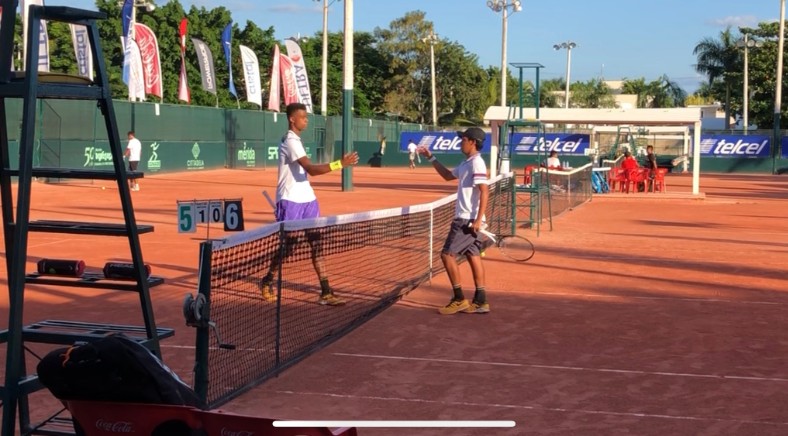
Players use a racket to hit a small yellow ball. They hit the ball over a net. The ball can bounce one time on the court. Then a player must hit it back.
Tennis has special words for scoring. The first point is called “15.” The next point is “30.” The point after that is “40.” If both players have 40 points, it is called “deuce.” A player must win two points in a row after deuce to win the game.
A player needs six games to win a set. Most matches have three sets. The biggest matches have five sets. The player who wins more sets wins the match.
There are four very famous tennis tournaments. People call them the Grand Slams. They are the Australian Open, the French Open, Wimbledon, and the US Open. They are played on different types of courts, like hard court, clay, and grass.
Vocabulary
- racket — the tool players use to hit the ball
- net — the low wall of material across the middle of the court
- court — the space where players play tennis
- serve — to hit the ball to start a point
- point — one small win in a game
- game — a small part of a set, made of points
- set — a bigger part of a match, made of games
- match — the whole contest between players
Comprehension Check
Discussion Prompts
- Have you ever played or watched tennis?
- Which sport in your country is as popular as tennis?
- Would you like to try playing tennis someday?
Intermediate
Tennis is one of the most popular sports in the world, played by two people (singles) or by four people split into two teams (doubles). Players use a racket to hit a felt-covered ball back and forth over a net, and the ball is allowed to bounce once before it must be returned.
The scoring system is one of tennis’s most distinctive features. Points are counted as 15, 30, and 40, and a score of zero is called “love.” If both players reach 40, the score becomes “deuce,” and a player must then win two points in a row to take the game. Winning six games (with at least a two-game lead) claims a set, and most matches are decided over three sets, though the biggest men’s tournaments use a best-of-five format.
Tennis courts also vary by surface, which changes how the ball bounces and how the game is played. Hard courts produce a fairly even, medium-paced bounce. Clay courts slow the ball down and create high bounces, favoring long rallies. Grass courts, now rare, produce a low and fast bounce that rewards aggressive play.
These surface differences are most visible at the four Grand Slam tournaments, the most prestigious events in tennis. The Australian Open and the US Open are played on hard courts, the French Open is played on clay at Roland Garros in Paris, and Wimbledon remains the sport’s only Grand Slam played on grass.
Vocabulary
- distinctive — unusual in a way that makes something easy to recognize
- claim — to win or officially take something
- surface — the top layer of the court that the ball bounces on
- rally — a series of shots exchanged before a point ends
- prestigious — respected and admired as very important
- aggressive — playing in a bold, forceful way
- format — the structure or system used for something
- exchange — to trade back and forth
Comprehension Check
Discussion Prompts
- Different court surfaces reward different playing styles. Do you think this makes tennis more interesting, or would you prefer one standard surface?
- Tennis scoring (love, 15, 30, 40, deuce) is unlike most other sports. Why do you think a sport might keep an unusual tradition like this?
- If you could attend one Grand Slam tournament in person, which would you choose and why?
Advanced
Tennis occupies a distinctive place among global sports, not least because of its idiosyncratic scoring system, a legacy structure that has persisted largely unchanged for well over a century. Points progress through 15, 30, and 40, with zero designated “love,” and a tied score of 40-40, or deuce, requires a player to win two consecutive points to secure the game. Six games, with a margin of at least two, constitute a set, and while most matches are contested over three sets, the men’s Grand Slam events retain a best-of-five format that places a premium on physical endurance as much as technical skill.
Court surface represents a second defining variable, one that shapes not only how the ball behaves but how the sport itself is played and, at times, dominated. Hard courts offer a relatively neutral, medium-paced bounce. Clay courts slow shots dramatically and produce a high bounce, rewarding patience, heavy topspin, and sustained rallies over outright power. Grass courts, now used at only a single Grand Slam, generate a low, skidding bounce that historically favored serve-and-volley players, though modern racket technology and baseline-oriented training have narrowed that advantage considerably.
These surface distinctions converge most visibly across the four Grand Slam tournaments, whose differing conditions have long shaped the careers and legacies of the sport’s greatest champions. The Australian Open and the US Open, both contested on hard courts, tend to favor a versatile, all-court game. The French Open, played on the red clay of Roland Garros, has historically rewarded a distinct set of physical and tactical attributes rarely dominant elsewhere. Wimbledon, the sport’s oldest and most traditional major, remains its only Grand Slam played on grass, a surface whose scarcity in the modern game only heightens its mystique.
Taken together, these structural quirks, an archaic scoring system and a rotating cast of court surfaces, help explain why tennis rewards such a wide range of playing styles, and why no single champion has ever fully dominated all four majors in a single era without contending with real variation in conditions.
Vocabulary
- idiosyncratic — unusual or peculiar in a distinctive way
- legacy — something inherited or carried over from the past
- endurance — the ability to withstand prolonged physical or mental strain
- topspin — forward-rotating spin on the ball that causes it to dip and bounce higher
- skidding — sliding or bouncing low with reduced upward force
- converge — to come together from different directions
- mystique — an aura of mystery or fascination surrounding something
- archaic — very old and no longer commonly used
Comprehension Check
Discussion Prompts
- The article argues that surface variation prevents any one playing style from dominating tennis entirely. Do you think this variety benefits the sport, or would more standardization make it easier to follow?
- Tennis has preserved an unusual scoring system for over a century. What do you think makes a tradition worth preserving in a sport, versus modernizing for simplicity?
- Consider the physical demands of a best-of-five-set match. How do you think endurance and mental resilience compare in importance to raw technical skill at the highest level?
General-knowledge lesson on tennis rules and terminology. No single external news source. Featured photo: Mariodg20, Wikimedia Commons, CC BY-SA 4.0.