
Beginner
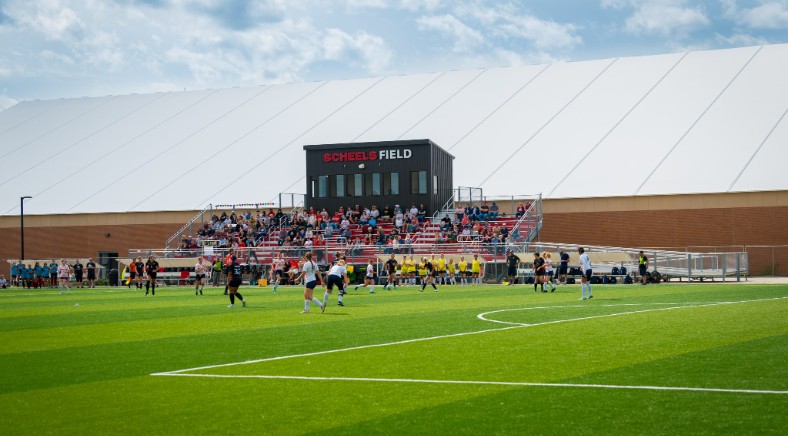
Soccer is the most popular sport in the world. Many people call it “football.” Two teams play against each other. Each team has eleven players on the field.
The goal of the game is simple. Players try to kick the ball into the other team’s goal. Only one player, the goalkeeper, can use their hands. All other players use their feet, legs, chest, or head.
A soccer match has two halves. Each half is 45 minutes long. That means a full match is 90 minutes. The team that scores more goals wins the match.
A referee watches the game closely. The referee makes sure players follow the rules. If a player breaks a rule, the referee can show a yellow card as a warning. A red card means the player must leave the game.
Every four years, the best national teams play in the World Cup. It is the biggest soccer tournament in the world. Millions of people watch it on television.
Vocabulary
- team — a group of players who play together
- field — the large grass area where soccer is played
- goal — the net where players try to score
- goalkeeper — the player who guards the goal
- referee — the person who enforces the rules
- score — to get a point by getting the ball into the goal
- match — a single game of soccer
- tournament — a series of matches to find one winner
Comprehension Check
Discussion Prompts
- Do you play or watch soccer in your country?
- What is the most popular sport where you live?
- Have you ever watched a World Cup match?
Intermediate
Soccer, known as football almost everywhere outside the United States, is widely considered the world’s most popular sport, played and followed by billions of people across nearly every country. Two teams of eleven players compete to send the ball into the opposing goal, using any part of the body except the hands and arms, with the exception of each team’s goalkeeper.
A standard match consists of two 45-minute halves, separated by a short break, and any time lost to injuries or substitutions is added at the end of each half by the referee. A single referee oversees play on the field, assisted by additional officials who help monitor the sidelines and, in many professional leagues, a video review system for close or disputed calls.
Players compete in defined positions that shape how a team attacks and defends. Forwards focus on scoring goals, midfielders link defense and attack while controlling the pace of play, and defenders work to stop opposing forwards from scoring. One of the sport’s more debated rules, the offside rule, generally prevents an attacking player from being closer to the opponent’s goal than both the ball and the second-to-last defender at the moment a pass is played.
Every four years, national teams from around the world compete for a place in the FIFA World Cup, a monthlong tournament regarded as the pinnacle of the sport and one of the most-watched events on Earth.
Vocabulary
- oppose/opposing — on the other, competing side
- substitution — replacing one player with another during a match
- oversee — to supervise or be in charge of something
- monitor — to watch and check regularly
- defined — clearly and specifically stated
- debated — discussed with different opinions, sometimes disputed
- pinnacle — the highest point or best example of something
- regarded — considered or thought of in a particular way
Comprehension Check
Discussion Prompts
- The offside rule is one of soccer’s most debated rules, even among longtime fans. Why do you think a rule can be widely followed but still frequently misunderstood or argued about?
- Video review systems are now used in many professional leagues to check close calls. Do you think added technology improves a sport like soccer, or does it change the game in ways that take something away?
- Soccer is followed by billions of people worldwide, more than almost any other sport. Why do you think it has become so universally popular compared to other sports?
Advanced
Soccer, referred to as football throughout most of the world, holds an essentially unrivaled claim to being the planet’s most widely played and followed sport, a status built on a combination of structural simplicity and near-universal accessibility. The sport requires little more than a ball and open space, a fact frequently credited with its rapid global spread across vastly different economic and cultural contexts. Two teams of eleven compete to advance the ball into an opposing goal using any part of the body other than the hands and arms, save for each side’s designated goalkeeper.
Matches unfold across two 45-minute halves, with stoppage time appended at the referee’s discretion to account for delays from injuries, substitutions, or other interruptions. Officiating has evolved considerably in recent decades, with a single on-field referee now typically supported by assistant officials and, in many elite competitions, a video assistant referee system designed to reduce the incidence of clear and obvious errors, albeit at some cost to the fluidity that has long defined the sport.
Tactical structure within a match is organized around a small set of positional roles, forwards, midfielders, and defenders, whose relative balance and coordination define a team’s broader style of play. Few rules generate as much ongoing debate as the offside law, which restricts an attacking player from being nearer to the opponent’s goal than both the ball and the second-to-last defender at the moment a pass is delivered, a regulation intended to prevent a tactic that would otherwise reduce the sport to a contest of simply “goal hanging.”
Every four years, this global following converges on the FIFA World Cup, a tournament whose cultural and economic significance extends well beyond athletic competition, drawing broadcast audiences that rank among the largest for any recurring event in human history.
Vocabulary
- unrivaled — having no equal or competitor
- accessibility — the quality of being easy to obtain, use, or take part in
- discretion — the freedom to decide something based on judgment
- incidence — the rate or frequency at which something occurs
- fluidity — the quality of flowing smoothly, without interruption
- coordination — the organized action of different parts working together
- converge — to come together toward a single point
- recurring — happening again repeatedly over time
Comprehension Check
Discussion Prompts
- The article suggests soccer’s global popularity stems partly from needing little more than a ball and open space. How much do you think accessibility, rather than skill or spectacle, drives a sport’s popularity?
- Video assistant referee technology reduces errors but, according to the article, may cost the sport some fluidity. Where do you personally draw the line between fairness and preserving a sport’s traditional flow?
- The World Cup’s influence is described as extending well beyond athletic competition. Can you think of other examples where a sporting event carries meaning that reaches beyond the game itself?
General-knowledge lesson on soccer rules and terminology. No single external news source. Featured photo: Bethany Lutheran College, Wikimedia Commons, CC BY-SA 4.0.