
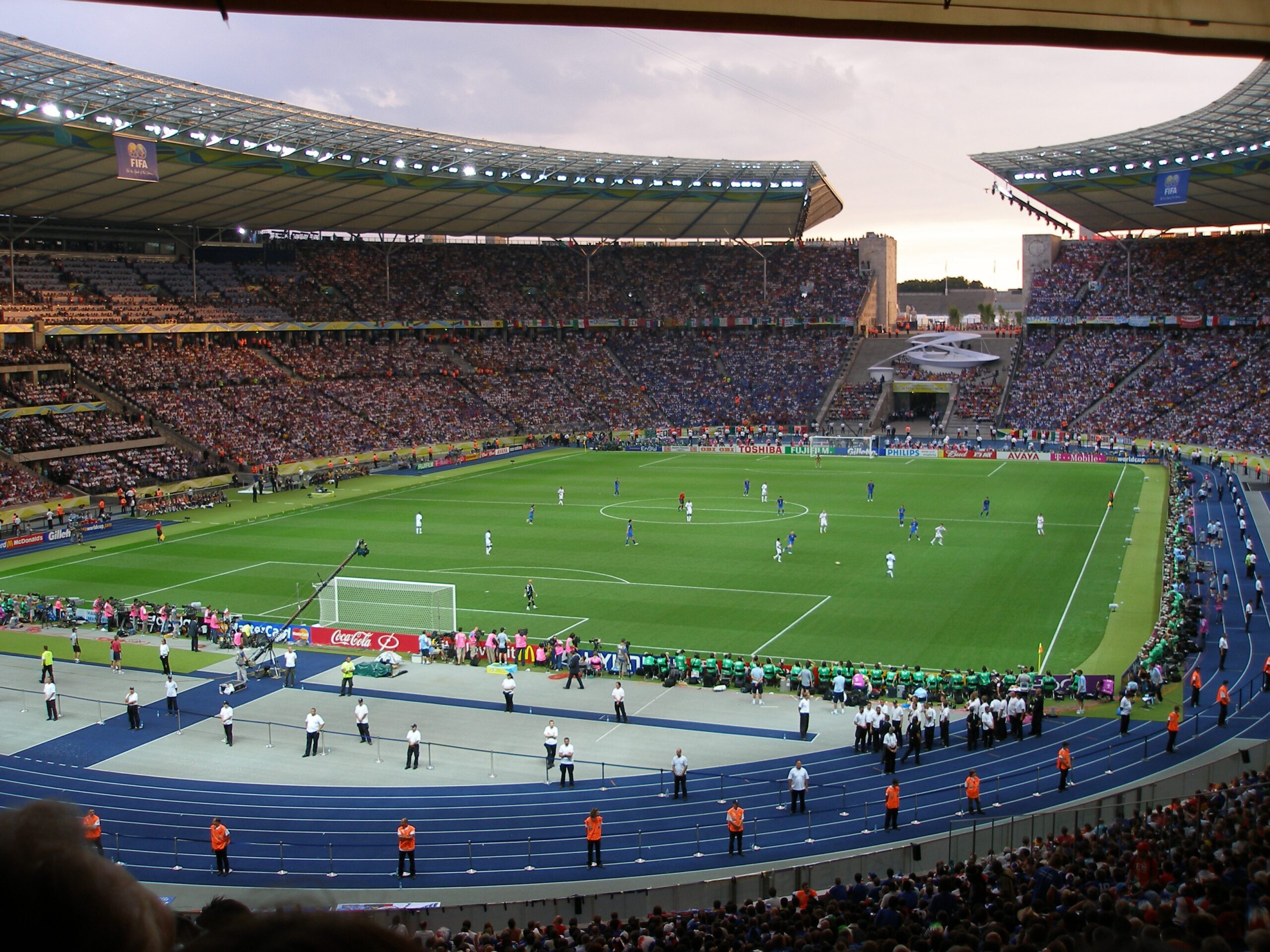
Today’s story, from UPI: World Cup 2026: Spain ends Argentina’s reign, wins second title (by Alex Butler, UPI, July 19, 2026).
🟢 Beginner
Reading
Spain won the 2026 World Cup! On Sunday, July 19, Spain beat Argentina 1-0 in extra time.
The game was in East Rutherford, New Jersey. More than 80,000 fans watched the game.
Spain played very well. They took 20 shots. Argentina only took 2 shots.
The winning goal came from Ferran Torres. He scored in the 106th minute, during extra time.
Spain’s goalie, Unai Simon, played amazing defense. He did not let in a single goal in the whole game! This was his seventh shutout of the tournament — a new World Cup record.
With this win, Spain became the first country ever to hold both the men’s and women’s World Cup titles at the same time.
Argentina played with only 10 players near the end. One of their players got a red card.
Spain’s player Rodri won an award for best player of the tournament. Another Spain player, Pau Cubarsi, won the award for best young player.
Vocabulary
- extra time — extra minutes added to a game when the score is tied
- fan — someone who watches and supports a team
- shot — an attempt to score a goal
- goalie — the player who tries to stop the other team from scoring
- shutout — a game where a team does not let the other team score at all
- record — the best result ever, officially measured
- award — a prize given for doing something well
- red card — a card a referee shows a player who must leave the game
Comprehension Check
Discussion
- Have you ever watched a sports game that went into extra time? How did it feel?
- Why do you think goalkeeping is such an important position in soccer?
- What do you think it takes for a team to win a championship two times in a row?
🟡 Intermediate
Reading
Spain capped off the 2026 World Cup with a 1-0 extra-time win over Argentina on Sunday, claiming its second title in dramatic fashion at New York-New Jersey Stadium in East Rutherford, N.J.
More than 80,000 fans packed the stadium to watch the final, one of the most closely contested matches of the tournament. Spain dominated much of the game, outshooting Argentina 20-2 and controlling 65% of possession, but couldn’t find the breakthrough until Ferran Torres netted the winner in the 106th minute.
Spain goalkeeper Unai Simon turned in a record-setting performance, recording his seventh shutout of the tournament — the most in World Cup history — and did not face a single shot on target in the final.
With the victory, Spain became the first nation in history to simultaneously hold both the men’s and women’s World Cup titles, while denying Argentina the chance to become just the third men’s team ever to successfully defend its championship.
Argentina played a man down for the final stretch of the match after midfielder Enzo Fernandez picked up a second yellow card in stoppage time, forcing the team into extra time with only 10 players.
Individual honors went to Spain’s Rodri, who won the Golden Ball as the tournament’s best player, and teammate Pau Cubarsi, who was named Best Young Player. Kylian Mbappe of France finished as the tournament’s top scorer, becoming the first men’s player to win the Golden Boot twice.
Vocabulary
- cap off — to complete or finish something in a memorable way
- dominate — to control most of a competition or event
- possession — control of the ball in a soccer match
- breakthrough — a moment of important progress after difficulty
- simultaneously — happening or existing at the same time
- defend (a title) — to try to win a championship again after already winning it
- stoppage time — extra minutes added at the end of a half to make up for delays
- honors — awards or recognition given for achievement
Comprehension Check
Discussion
- Spain dominated in shots and possession but didn’t score until extra time. What does this suggest about the difference between controlling a game and finishing it?
- What do you think makes defending a championship title so difficult, especially compared to winning it the first time?
- Individual awards like the Golden Ball and Golden Boot exist alongside team trophies. Why might these individual honors matter to players and fans?
🔴 Advanced
Reading
Spain brought the curtain down on the 2026 World Cup in dramatic fashion Sunday, grinding out a 1-0 extra-time victory over Argentina at New York-New Jersey Stadium to claim its second title and cement a piece of soccer history in the process.
Playing before a crowd of more than 80,000 in East Rutherford, N.J., Spain asserted near-total control of the match, outshooting Argentina 20-2 and dominating possession at a 65-35 clip, yet found the Argentine defense — anchored by a heroic Emiliano Martinez, who finished with 11 saves — stubbornly resistant until substitute Ferran Torres finally broke through in the 106th minute, glancing in a headed knockdown from teammate Nico Williams.
At the other end, goalkeeper Unai Simon authored a tournament for the ages, closing out his seventh clean sheet of the competition — an all-time World Cup record — without facing a single shot on target in the final itself. The result made Spain the first nation in history to simultaneously hold both the men’s and women’s World Cup crowns, while simultaneously denying Argentina what would have been just the third successful men’s title defense ever.
Argentina’s task grew considerably harder in the match’s closing stages, as midfielder Enzo Fernandez picked up a second caution in stoppage time and was sent off, forcing La Albiceleste to play the entirety of extra time a man down against a Spanish side already controlling the run of play.
Individual accolades rounded out the tournament’s narrative: Spain’s Rodri claimed the Golden Ball as the competition’s outstanding player, defender Pau Cubarsi was recognized as the tournament’s Best Young Player, and France’s Kylian Mbappe closed out the Golden Boot race with 10 goals, becoming the first men’s player in World Cup history to win the award in consecutive tournaments.
Vocabulary
- grind out (a result) — to achieve a difficult win through effort rather than ease
- cement (a legacy/history) — to make something permanent or firmly established
- assert control — to establish clear dominance in a contest
- stubbornly resistant — persistently difficult to overcome
- clean sheet — a game in which a goalkeeper’s team does not concede a goal
- caution — a formal warning from a referee, often shown with a yellow card
- narrative — the overall story or way events are framed
- accolade — an award or expression of praise for an achievement
Comprehension Check
Discussion
- The article frames Spain’s win as both a team triumph and a collection of individual milestones (Rodri’s Golden Ball, Simon’s shutout record, Mbappe’s repeat Golden Boot). How do individual and team accomplishments interact in a tournament like the World Cup?
- Argentina controlled far fewer shots and possession but still nearly forced the match to penalties. What does this suggest about the role of goalkeeping and defensive resilience in high-stakes matches?
- Consider the significance of a nation holding both men’s and women’s World Cup titles simultaneously. What might this achievement suggest about a country’s broader investment in the sport?
📣 Share This Lesson
Spain made history: first country ever to hold both the men’s and women’s World Cup titles at once! ⚽🏆 Read today’s story and test your English. #ESL #EnglishLearning #immersionesl
Source: “World Cup 2026: Spain ends Argentina’s reign, wins second title” by Alex Butler, UPI (July 19, 2026).